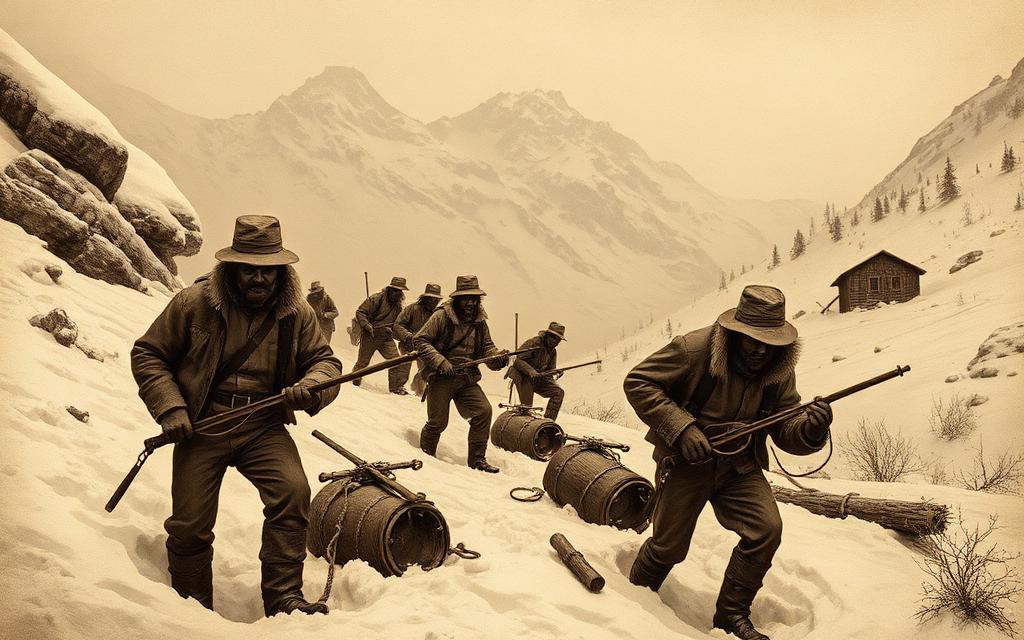
Alferd Packer: Colorado's Cannibal
Greed and a bad case of gold fever had taken hold of 6 men during the winter of 1873. Alferd Packer was the only survivor of an ill-considered expedition to the rich gold fields of the San Juan Mountains. This would not have been such an unusual occurrence, except Alferd came out of the mountains after two months well fed and not starved—and his story would soon show why.
The Ill-Fated Expedition
In 1873, Alfred Packer, 31, went with a group of 20 other prospectors from Bingham Canyon, Utah, near Salt Lake City, into the San Juan Mountains in Colorado to seek wealth from mining minerals, including gold. He claimed to have been the guide for this expedition, but there is evidence that this may have been an exaggeration if not an outright fabrication. Apparently some of the food supply was lost along the way, and the would-be miners grew hungry and desperate.
Chief Ouray's Warning
The party arrived in January 1874 into Chief Ouray's Ute camp in northwestern Colorado, near Montrose, where they were cared for and urged to remain until spring. At that time of year, the mountain passes were treacherous, the Ute said, and snow could bury men. It would not be wise to proceed.
Nevertheless, a handful of these prospectors could not wait. They wanted to get to the mines before anyone else. Five of them, frenzied by the prospecting spirit, decided to risk all and continue over the mountains to the Los Piños Indian Agency on Cochetopa Creek near Saguache and Gunnison. Packer joined them. They left on February 9. Packer claimed that another group of five had gone out before them and they wanted to be first on the mine claims in the spring.
The Doomed Party
With a 10-day supply of food for a 75-mile trip (they apparently thought it was 40), the doomed men who left Chief Ouray's camp with Packer were:
- Shannon Wilson Bell
- Israel Swan
- James Humphrey
- Frank "Reddy" Miller
- George "California" Noon, who was only 18
Aside from Packer, that was the last time anyone saw these men alive.
The Lone Survivor
Two months later, in April 1874, Packer arrived alone at the Los Piños Indian Agency. Despite claiming to have been lost and starving in the wilderness for weeks, witnesses noted that Packer appeared surprisingly well-nourished and healthy. He had money in his pockets—money that would later be identified as belonging to some of his missing companions.
Packer's stories about what happened to the other five men changed multiple times. He claimed they had abandoned him, that they had gotten separated, that Indians had attacked them. Each version had inconsistencies that aroused suspicion.
The Grim Discovery
In August 1874, an artist named John A. Randolph stumbled upon a gruesome scene near the shores of Lake San Cristobal, not far from the present-day town of Lake City. He found the remains of the five missing prospectors. The bodies showed clear signs of violent death—and cannibalism.
Four of the men had been killed by blows to the head with a hatchet. Their bodies had been stripped of flesh, apparently consumed over the course of the winter. Packer was arrested and eventually confessed, though his confession varied in details over time.
Trial and Sentencing
Packer escaped custody in 1874 but was recaptured nine years later in Wyoming, living under an alias. He was tried in Lake City in 1883 for the murder of Israel Swan. The trial was a sensation, drawing national attention.
According to legend (though likely apocryphal), Judge Melville Gerry sentenced Packer with the words: "Stand up, you voracious man-eating son of a bitch! There were only seven Democrats in Hinsdale County, and you ate five of them!"
Packer was sentenced to death, but his conviction was later overturned on a technicality. He was retried and convicted of five counts of manslaughter, serving 17 years in prison before being paroled in 1901. He died in 1907.
The Grizzly Details - Packer's Confession
Right away, poor weather conditions hindered the party's progress, Packer said, and their supplies eventually ran out. Streams and lakes were too frozen or treacherous to fish, and wild game was scarce. They could not turn back, but they were not optimistic about going forward, either. Since they were already starving, their situation looked bad and they became desperate.
Packer's statement to General Adams indicated that the other five men had died at various stages of their journey, either as starvation and exposure overtook them or as they were killed in self defense from one another's hunger-maddened attacks. Ultimately, the bodies were found at various places along the trail.
The Order of Deaths
Israel Swan, being the oldest at around 65, died first, about 10 days after the group departed, and the survivors had all taken pieces from him to eat.
Then four or five days later, James Humphrey died and was also eaten. He proved to have "33 in his pocket and Packer admitted that he had taken it. James was no longer going to need it, so why not?
The third man to die was Frank Miller, Packer referred to him as "the Butcher", in an accident that occurred while Packer was searching for wood. He did not go into detail about what kind of accident. The other two who were still alive decided to eat him, since he was dead, and Packer returned to find this activity already in progress.
The next to go was young George Noon. Packer reported that while he was off for several days hunting for game, Bell had shot California (Noon) with Swan's gun. Packer had returned and together they ate him. That left only Packer and Bell.
Bell decided that he was going to be the only survivor. Packer's statement reports: "Bell wanted to kill me, he struck at me with his rifle, struck a tree and broke his gun. So I (Packer) had to kill him first."
It is obvious why Packer had not offered this tale immediately upon returning to the settlement, but is not made clear in his confession, and perhaps was not even questioned. He swore that this statement was "the truth and nothing but the truth, so help me God."
Legacy
After his trial at the courthouse in Gunnison, Alfred Packer was given 17 years in the penitentiary. Alfred was eventually paroled and found work as the doorman at the Denver Post Newspaper in Denver. He is buried in Littleton in the Prince Street cemetery in a military grave. Colorado Highway 149 to Lake City is known as the Cannibal Trail.
Today, the Alferd Packer story remains one of Colorado's most infamous tales. The site where the bodies were discovered is marked, and the story has inspired everything from academic studies to the University of Colorado's "Alferd Packer Memorial Grill" in the student union.